
State of Social 2026: What the Trust Gap Means for
Trade Show Exhibitors and Brand Managers
Social media didn’t just change again, it re-ordered the rules.
TikTok Shop is outpacing Amazon. AI influencers are driving real purchases. User behavior inside Meta has shifted. And the platforms breaking usage records aren’t necessarily the ones most brands are betting on. But under all of those headlines is the real story: trust is breaking down, and brands that don’t adapt are getting punished in public.
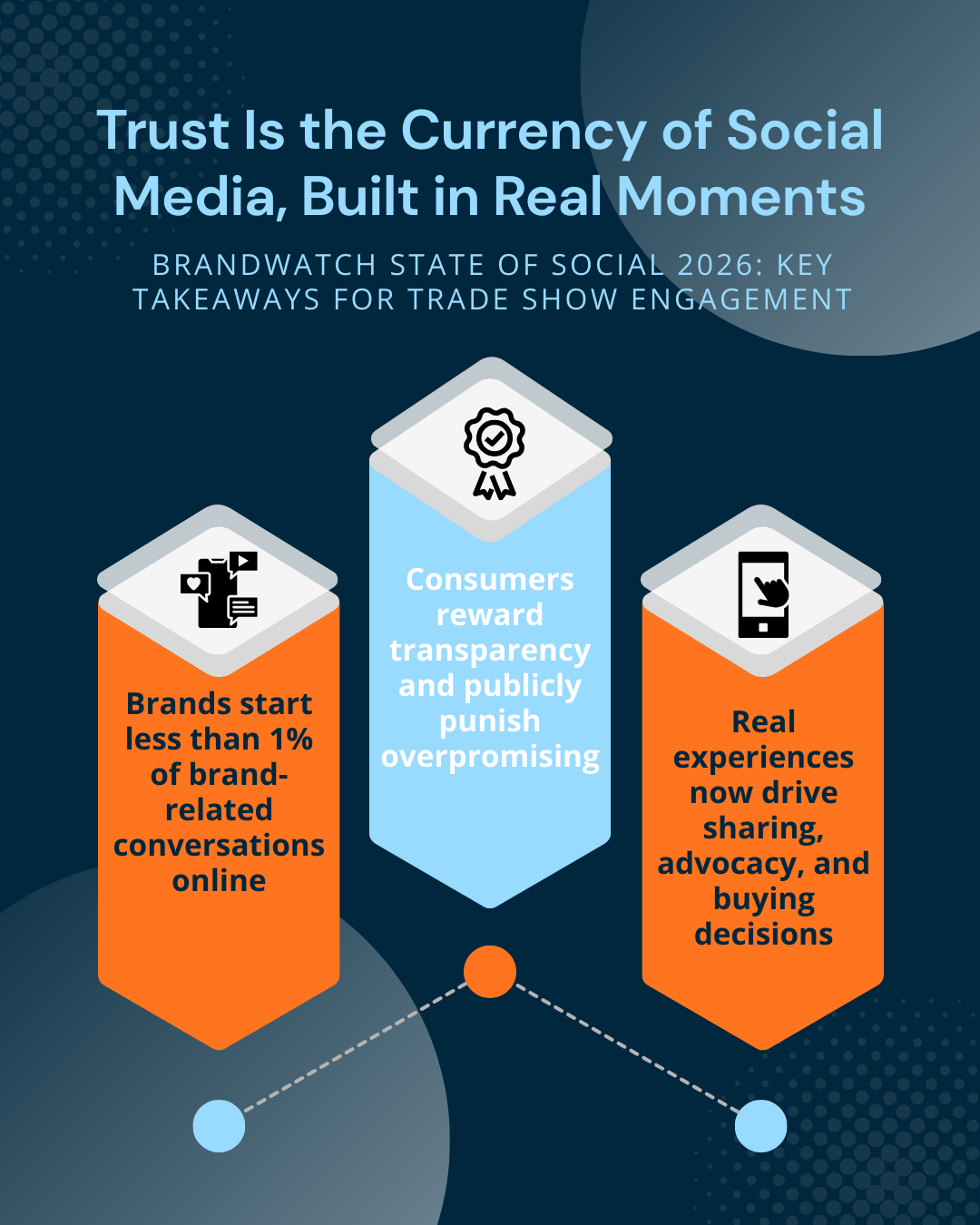
Brandwatch’s 2026 State of Social research points to a hard truth: brands initiate less than 1% of brand-related conversations online. The other 99% is happening without you, between customers, prospects, creators, employees, and competitors’ fans. That’s where trust is earned (or lost), and that’s where buying decisions are being shaped.
For trade show exhibitors and brand managers, this matters more than ever because your booth, your onsite experience, and your follow-up aren’t separate from social; they’re fuel for it. The show floor is no longer a moment in time. It’s content, credibility, and conversation, before, during, and long after the event.
Below is what’s changing in 2026, and how to turn those shifts into practical wins for your next trade show program.
Why social trust now directly impacts trade show ROI
The best exhibits don’t just “look good.” They create belief.
And belief is the currency social runs on in 2026.
When trust is high, audiences:
stop and engage
share your content
recommend you to colleagues
defend you when criticism shows up
buy with confidence
When trust is low, audiences:
scroll past
assume you’re hiding something
amplify negative experiences
“deinfluence” others away from you
turn small disappointments into public warnings
That’s not theoretical. The report highlights rising online frustration around:
hidden fees and extra charges (up 40% in 2025)
“deinfluencing” content calling out products that don’t deliver (up 79% in 2025)
boycott and “do not buy” language (surging 95% in the first half of 2025)
ad fatigue (with 54% of ad-related conversations showing anger)
digital overload and “digital detox” momentum (up 10% in early 2025)
In other words: people are not just buying products, they’re buying proof.
Trade shows are one of the few places where brands can create that proof in real life.
1) Turning transparency gaps into honesty wins (on the show floor)
The social problem: Customers are exhausted by surprises, fees, unclear pricing, products that don’t match the promise.
The trade show opportunity: Use your booth to remove uncertainty.
What this looks like in a booth
Clarify the “real cost”: If your offer has tiers, setup fees, implementation timelines, or add-ons, make the structure visible and easy to understand.
Show what’s included: A simple “What you get / What you don’t” display builds instant trust.
Be honest about fit: Create a quick “Best for / Not ideal for” guide. Counterintuitive? Yes. Effective? Extremely.
Content to capture onsite (that builds trust)
Behind-the-scenes product demos (no heavy scripting)
“Here’s what surprised customers at first and how we fixed it” stories
Transparent comparisons (even if you don’t “win” on every dimension)
Bottom line: In a world of deinfluencing, your booth should be designed to create reassurance.
2) Turning bad experiences into brand loyalty
The social problem: Customer service complaints are loud, sticky, and contagious. “Do not buy” posts are rising fast.
The trade show opportunity: Make service visible, human, and immediate.
Trade shows are one of the only places where customers can see how your team behaves in real time.
“Service signals” that matter onsite
A clear help desk or support point (even if you’re not “support”)
Fast follow-up promises that you actually keep
A “We’ll own it” escalation path (name + method + timeframe)
The report notes a surge in positive conversation around helpful customer service and growing acceptance of chatbots when they’re implemented well. Take the lesson: people don’t hate automation, they hate feeling dismissed.
So if you use AI in your customer journey, your booth needs to show the opposite:
listening
clarity
real resolution
Bottom line: The booth is not a sales stage. It’s a trust test.
3) Turning digital overload into mindful engagement
The social problem: Social isn’t as “fun” as it used to be. Anxiety mentions are up. Digital detox is gaining traction.
The trade show opportunity: Build a booth that feels like a relief, not another demand.
Design for calm, not chaos
Fewer messages, bigger type, more whitespace
Simple product navigation (1–3 hero stories, not 12 competing ones)
Comfortable, inviting micro-environments (a lounge that signals “you can breathe here”)
Program for permission-based engagement
Offer “no-scan” browsing zones (yes, really)
Create a quiet 5-minute product walkthrough on a set schedule
Use signage like: “Want the fast version or the deep dive?” (give control)
When you respect attention, people reward you with it.
Bottom line: The most modern booths don’t shout. They invite.
4) Turning ad fatigue into value-first connections
The social problem: Clickbait and intrusive ads are losing the room, nearly 90% of clickbait mentions in 2025 were negative.
The trade show opportunity: Make your booth’s content genuinely useful.
Your exhibit is content. Your staff is content. Your demo is content.
So ask: would someone share this because it helped them?
Value-first booth content ideas
“Cost calculator” style visuals
Checklists and templates attendees can use Monday morning
“Common mistakes” teardown walls (what not to do + how to fix it)
Live mini-audits (packaged as education, not a pitch)
The report frames the new requirement clearly: credibility is what makes content resonate.
Bottom line: If your booth experience feels like an ad, people treat it like one, by tuning it out.
5) Turning superficial influence into authentic impact (and better leads)
The social problem: People are pushing back against overly polished influencer content and sponsor-heavy posts. Authenticity is climbing, mentions of authenticity in influencer conversations grew 66%.
The trade show opportunity: Use creators strategically, not cosmetically.
What works now
Micro-influencers with niche credibility (especially in B2B sub-communities)
Creator-led walkthroughs that feel like a peer sharing a find
Behind-the-scenes “how it’s made” content during setup
If you invite creators onsite, don’t script them into a commercial. Give them access, stories, and honest answers.
Bottom line: The influencer era isn’t dying. The fake influencer era is.
6) Turning AI anxiety into a human-first approach
The social problem: People are uneasy about AI: privacy, job displacement, environmental impact, and loss of human connection.
The trade show opportunity: Demonstrate AI as support, not replacement.
How to message AI without triggering distrust
Explain “what AI does” and “what it never does”
Be clear about data: what you collect, what you don’t, how it’s used
Show human oversight (who reviews, who approves, who’s accountable)
If your product includes AI, your booth should include human proof, team members who can explain it plainly, plus examples that show real-world benefit.
Bottom line: In 2026, “AI-powered” isn’t persuasive unless it’s also human-safe.
How to execute on social media in 2026 (with trade shows as the engine)
Here’s the play: treat your trade show program as your most credible social campaign.
Because while brands may initiate less than 1% of online conversations, you can influence the other 99% by creating moments worth talking about.
A simple trade show → social system that works
Before the show
Publish a “What we’ll show / What we won’t” preview (transparency)
Share setup planning, prototypes, or decision tradeoffs (honesty beats polish)
Invite audience questions to shape onsite demos (listening)
During the show
Capture proof: real demos, real reactions, real behind-the-scenes
Make customer experience content: “stress-free” moments, fast help, clear answers
Use platform-native formats (Reels, TikToks, LinkedIn short posts, Reddit-friendly threads)
After the show
Post what you learned (including what surprised you)
Follow up with value assets tied to conversations you had (not generic blasts)
Share customer stories with specifics: outcomes, constraints, tradeoffs
The takeaway for exhibitors and brand leaders
The biggest shift in social isn’t a platform. It’s a standard.
Trust has become the real currency. And trade shows, done right, are one of the strongest trust-building channels left.
If your booth can deliver radical clarity, human service, mindful design, and honest storytelling, you don’t just win the show floor.
You win the conversation that happens after it.
Contact our booth design experts to discuss how we can help you create engaging experiences that resonate on the show floor and on social media.